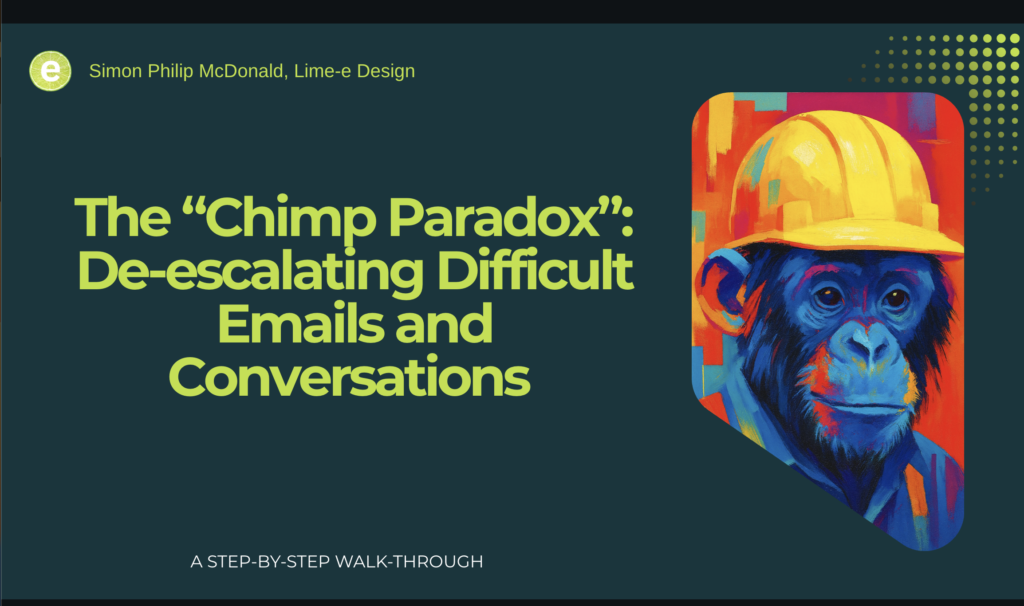
This project is a scenario-based learning experience built in Articulate Storyline, designed to explore decision-making and emotional regulation under pressure in a realistic workplace context.
It was developed as a flagship portfolio piece to demonstrate my approach to scenario design, learner judgement, and instructional trade-offs when the goal is depth, realism, and behavioural reflection rather than speed of deployment.
Structure and pacing informed by core learning science principles, particularly cognitive load, worked examples, and transfer to real-world decision-making.
This project uses intermediate to advanced Storyline functionality to create controlled branching, adaptive feedback, and a narrative-driven experience.
Timeline & Sequencing
Branching Architecture
Layers & Slide Management
Triggers & Conditional Logic
Variables
States
User Interaction
Media Integration
Workplace decisions are rarely made in calm or neutral conditions. They are made under pressure, with incomplete information, emotional load, and social consequences.
For soft skills training in particular, understanding concepts is not enough. Learners need to recognise themselves in situations that feel familiar and even slightly uncomfortable. Without that recognition, learning remains theoretical and fails to prepare people for real behaviour change.
This project is built on the belief that emotional realism is not a nice “optional extra” in workplace learning, but a requirement for developing skills such as self-regulation, communication, and decision-making.
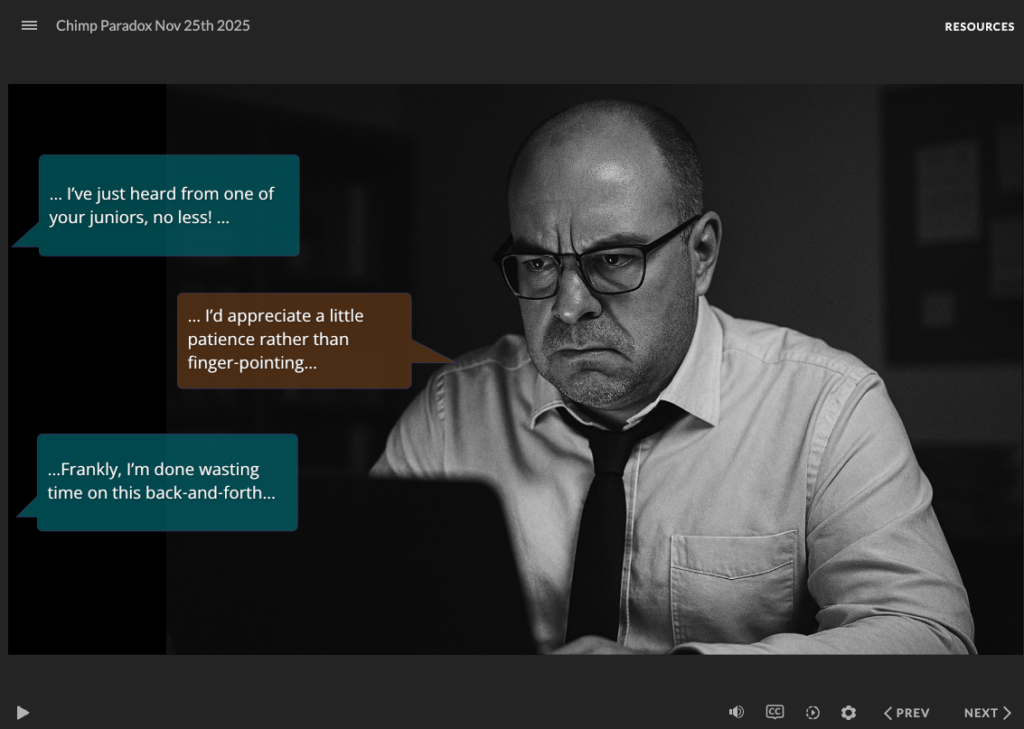
The Chimp Paradox, a mind-management model, was used here as a simple mental model. Learners are not expected to understand the theory in advance (those who already do can skip the explainer section that appears later). Instead, the design allows learners to experience moments of pressure, ambiguity, and reaction first, and only then reflect on what happened.
Scenarios were deliberately grounded in everyday workplace interactions. Emails are imperfect. Context is partial. Decisions involve trade-offs rather than clear right or wrong answers. These choices were intentional. Smoothing them away would have made the learning easier to consume, but less useful and less “sticky”.
Emotional realism in this project is not about provocation or stress for its own sake. It is about creating conditions where reflection and self-regulation can begin, and where learners have something concrete to work with before applying those skills back in the workplace.
In many workplace learning programmes, success is measured by what learners can recall rather than how they behave. Content is often structured around explanations and best practice, with the assumption that understanding will naturally translate into action. In practice, this transfer frequently fails.
Behaviour change requires more than awareness. It requires opportunities to make decisions, experience consequences, and reflect on outcomes.
For soft skills especially, knowing the “right” response is very different from being able to choose it under pressure.
This project was designed around the principle that learning should prioritise practice over explanation. Knowledge supports behaviour, but it does not replace it.
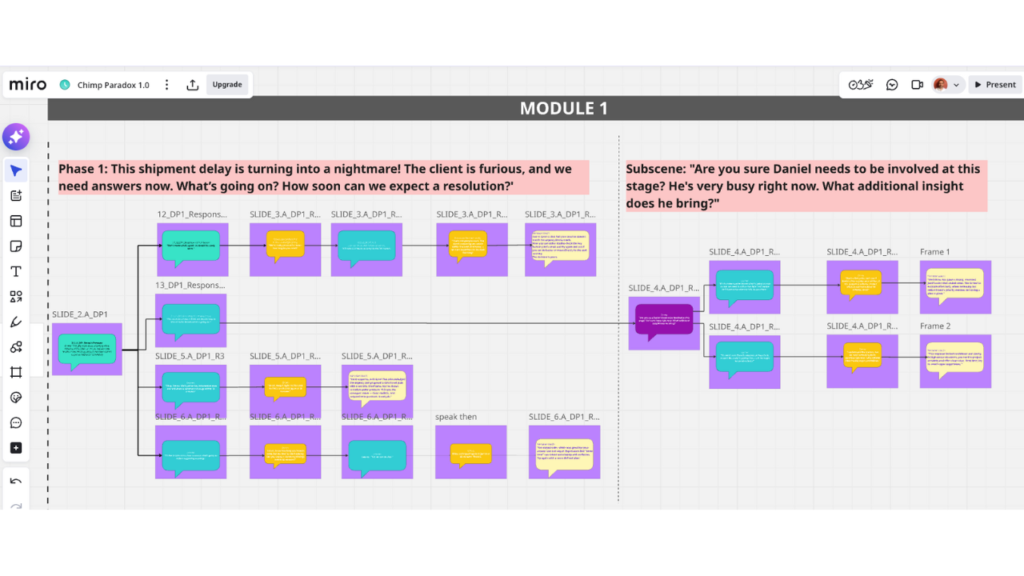
Rather than front-loading explanations, this project deliberately drops (or “helicopters”) learners straight into situations where they must interpret information, make decisions, and respond. Branching scenarios and decision points are introduced early to shift the learner from observer to participant. Explanations and frameworks appear later, once learners have had time to notice and reflect on their own reactions, while some content that could have been explained is intentionally left unsaid.
The goal was not completeness, but focused practice. This type of e-learning is designed to work best alongside manager support, facilitated sessions, and ongoing reinforcement, rather than in isolation. Used well, it provides a shared reference point for reflection, discussion, and follow-up, rather than attempting to drive behaviour change through a single course alone.
The real world involves friction and, sometimes, lots of it! Ambiguity, emotional load, competing priorities (not to mention personal factors such as tiredness, stress, or strained relationships). Learning that glosses over these elements may be easier to consume (click next!), but it is also less reflective of how decisions are actually made at work.
In soft skills learning, friction is often reduced through over-explaining, over-structuring, and smoothing away uncertainty. This frequently ends up patronising the learner, which leads to a loss of attention and motivation – the bedrock of good learning.
Adult learners do not need their intelligence protected. They need learning that respects their experience and challenges them enough to push beyond their comfort zone. So the question is not “if” friction belongs in learning, but “how much?”. Too little and learning becomes abstract. Too much and it becomes overwhelming.
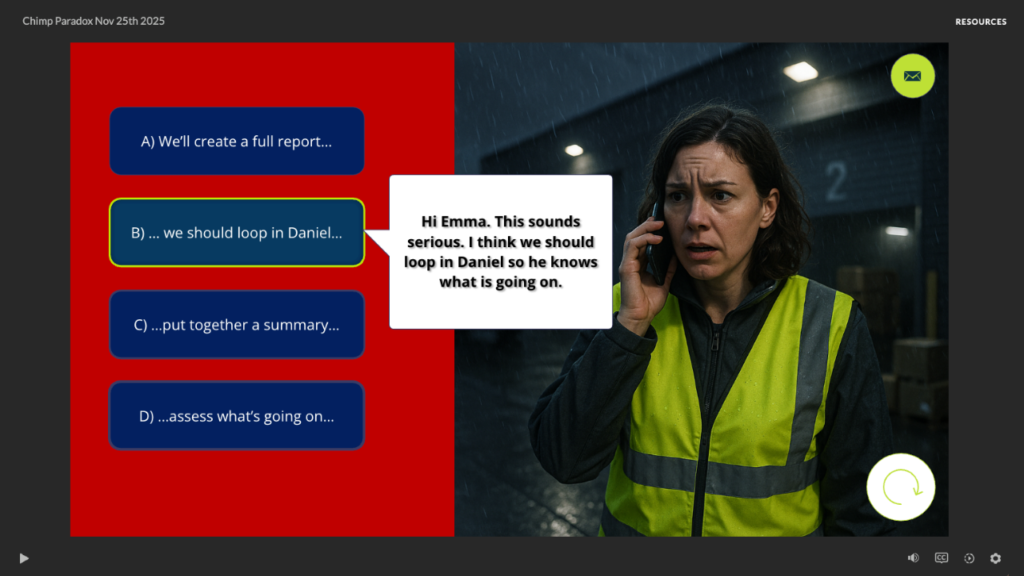
This project deliberately retains ambiguity, imperfect information, and trade-offs. Learners are expected to interpret, decide, and reflect, rather than being walked step by step towards a “correct” answer.
At the same time, friction is managed. Scenarios are short, consequences are instructional rather than punitive, and reflection is built in. The aim is not to provoke stress or “catch learners out”, but to surface habits and responses in a way that remains usable.
As mentioned earlier, this type of e-learning is not intended to work in isolation. It is designed to create shared reference points that can be picked up in workshops, manager conversations, or follow-up activity, where learning is reinforced and contextualised.
This project was designed within the kind of constraints that exist in real workplace learning. Time, attention, cognitive load, and production effort all had to be managed deliberately, and many decisions were driven as much by what to cut as by what to include.
The structure was kept intentionally simple. Scenarios are short and specific, explanations are light, and interactivity is used only where it supports decision-making or reflection. The aim was not completeness, but something that could realistically be built, maintained, and used alongside workshops or manager-led activity.
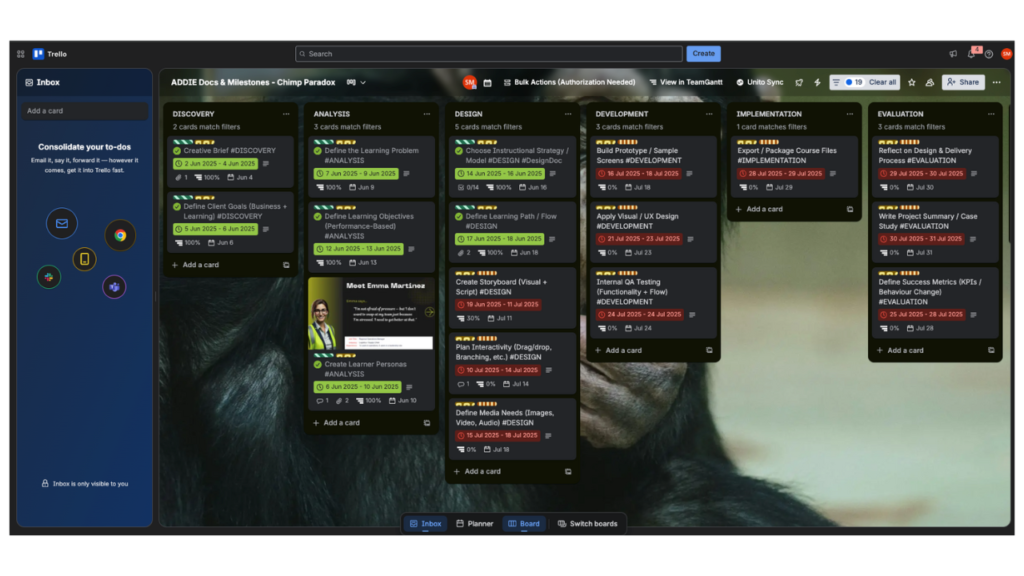
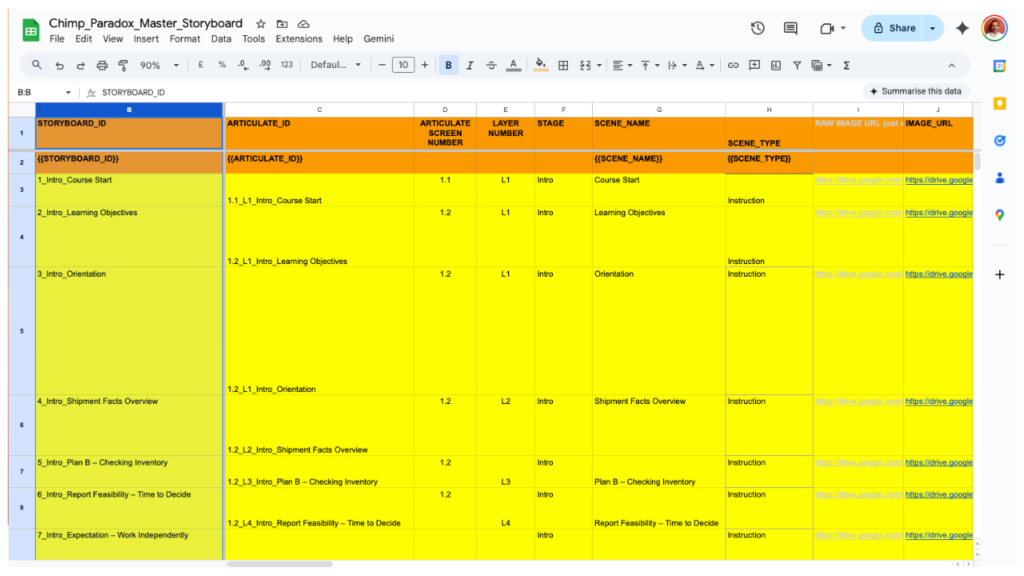
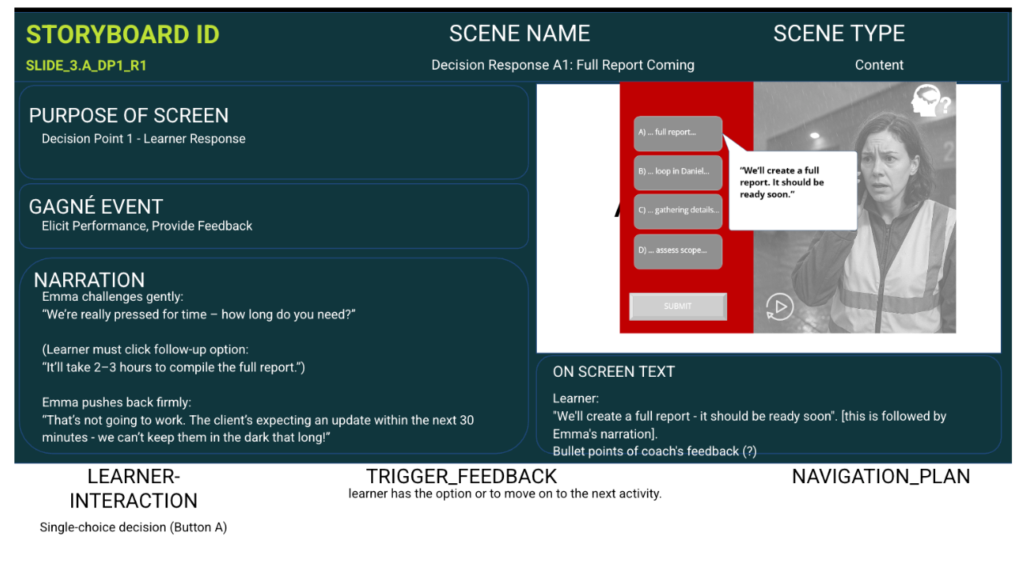
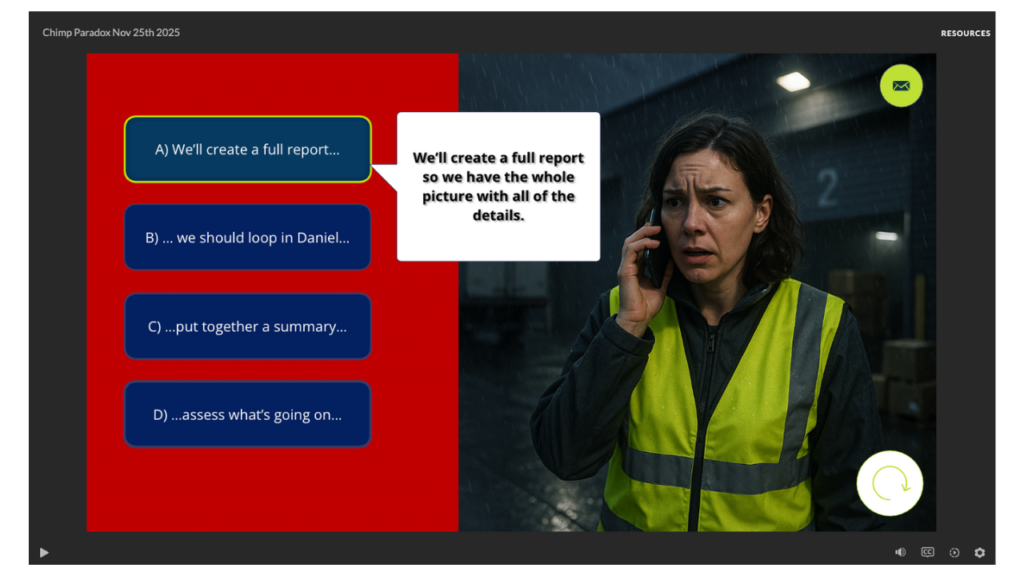
Planning played a central role in keeping the project grounded. Storyboards, task boards, and iteration notes were used to separate design thinking from production execution, making it easier to test ideas early, adjust structure, and avoid rework once development was underway. By externalising structure and decisions at this stage, trade-offs became visible earlier, scope was easier to challenge, and the project stayed aligned with its original intent as it moved into Storyline.
The DLI deliverables acted as a useful forcing function here, encouraging clarity of purpose and design rationale without locking the solution too early, and allowing space for iteration while maintaining momentum.
While I was not new to designing learning experiences, this project involved a genuine learning curve, particularly in formal instructional design and in articulating decisions that had previously been instinctive. The DLI programme helped me slow down, name those instincts more clearly, and test them against established frameworks.
Theory was useful less as a set of rules and more as a way to check my thinking. In some cases it confirmed choices I would likely have made anyway. In others, it highlighted gaps, risks, or alternative approaches that improved the final design. Being able to justify decisions more explicitly was both clarifying and empowering.
This project reflects that balance. It shows learning in progress, but also an ability to integrate new theory into an existing professional practice rather than starting from scratch.
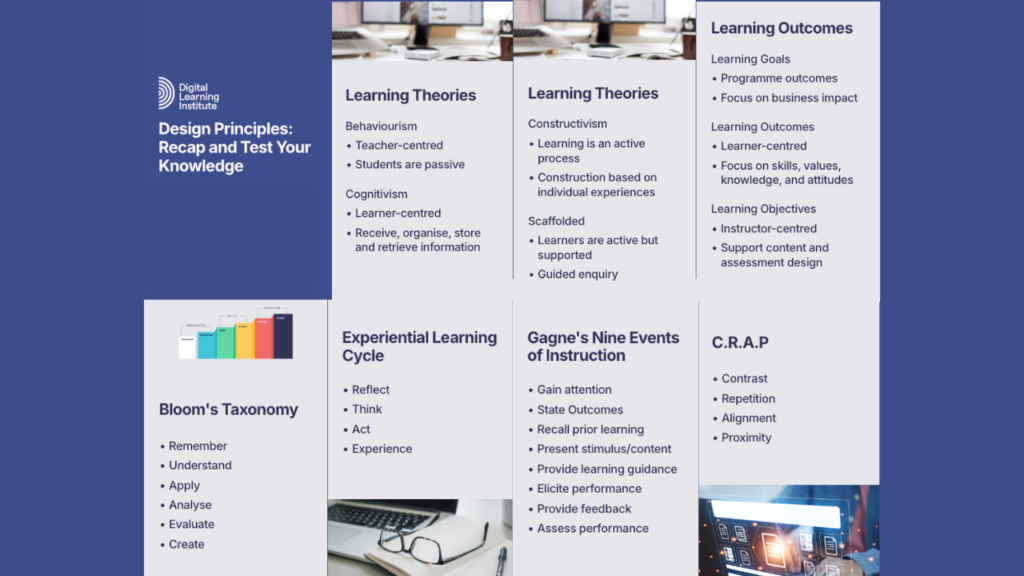
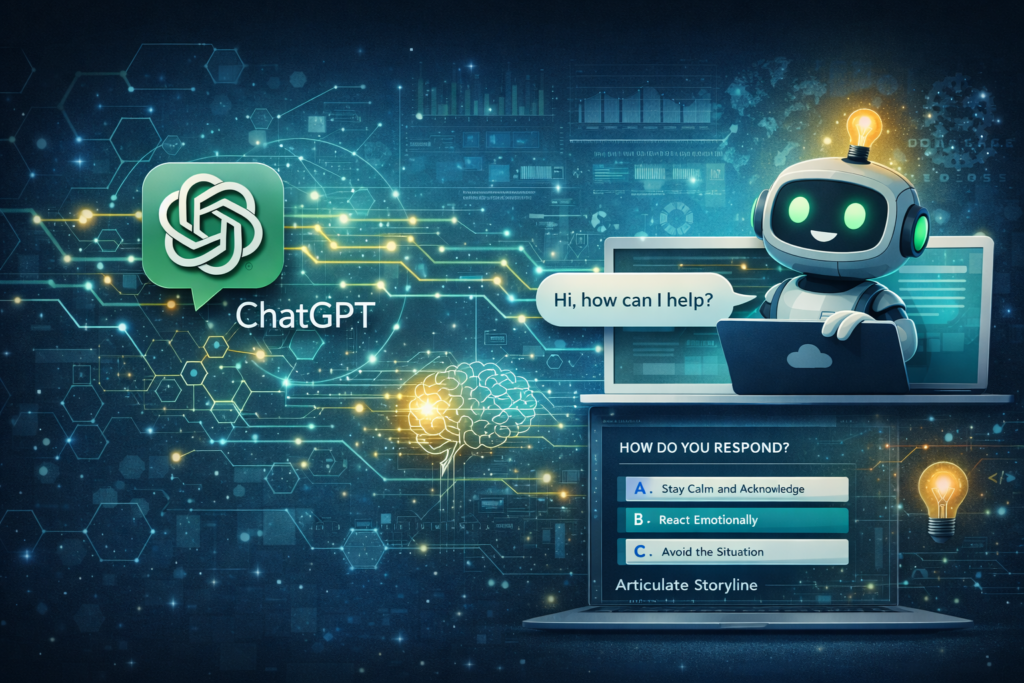
AI was used throughout the project as a support for thinking rather than a shortcut for content creation. It helped me articulate ideas, explore alternative approaches, and reflect on design decisions, particularly when moving between instinctive judgement and more formal design language.
In practice, this meant using AI to clarify reasoning, challenge assumptions, and improve structure, while retaining responsibility for all final decisions. Where suggestions did not fit the audience, context, or intent, they were simply discarded.
Used this way, AI, theory, and experience reinforced one another. Instinct provided direction, frameworks added rigour, and AI supported iteration. Together, they made it easier to think clearly without becoming rigid or over-engineered.
I was clear early on that I wanted to work in Storyline for this project. Partly out of curiosity and enthusiasm (and knowing how important it is in the job market), but also because I already had a strong sense of the kind of experience I wanted to design. The project relied heavily on storytelling, branching scenarios, and learners making judgements rather than selecting correct answers, all areas where Storyline performs particularly well.
Choosing Storyline was therefore not about technical ambition for its own sake. It was about having the flexibility to design interactions where learner decisions could be tracked, responded to, and revisited in a way that felt coherent rather than scripted. There was a learning curve, but it was a purposeful one and my years of experience using other authoring tools came in useful.
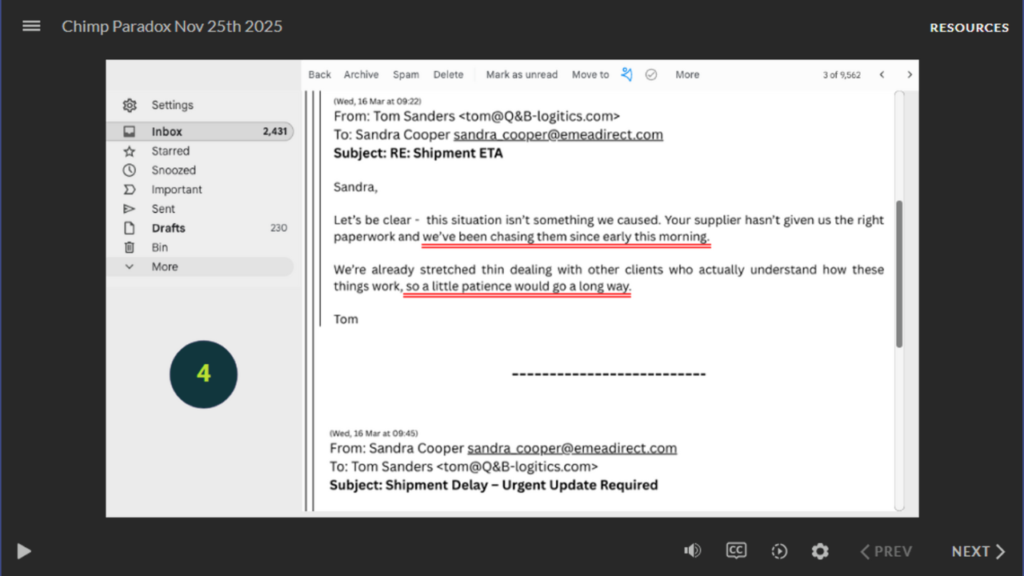
One example of this approach is the email module where learners are asked to identify “Chimp” phrases within a realistic workplace message. The interaction borrows from game design, not in the sense of “points, badges, or competition”, but rather through observation, pattern recognition, feedback, and progression.
These mechanics are used to sharpen attention and focus. Identifying emotionally charged language requires judgement rather than recall, and the interaction makes that judgement visible. Learners can see what they noticed, what they missed, and how their interpretation compares with alternative readings.
Storyline made it possible to build this interaction in a way that felt responsive and deliberate rather than static or quiz-like. Few other authoring tools would have allowed the same level of control without flattening the experience.
With more time, I would explore a small number of scenarios in greater depth rather than adding breadth. This would allow more space to observe how learner decisions evolve over multiple moments, rather than within a single interaction.
I would also involve stakeholders earlier in reviewing scenario tone and language. While the current design is intentional, earlier external feedback would help calibrate realism even more precisely for different organisational contexts.
For future development, I will be exploring how AI can be integrated to complement the project with ‘real-time’ feedback for written (email) exchanges and (oral) roleplay simulations.
I would not soften the scenarios to make them more comfortable. The friction built into the interactions is deliberate and necessary for reflection to take place.
I would not replace decision-making with explanation. Allowing learners to act before being told what to think remains central to the design.
And I would not treat this module as a standalone solution. Its value lies in how it feeds discussion, coaching, and reinforcement beyond the screen.
If this approach to learning design resonates, I’m always open to conversations about projects, roles, or collaborations where realism, judgement, and thoughtful design matter. Feel free to get in touch.